
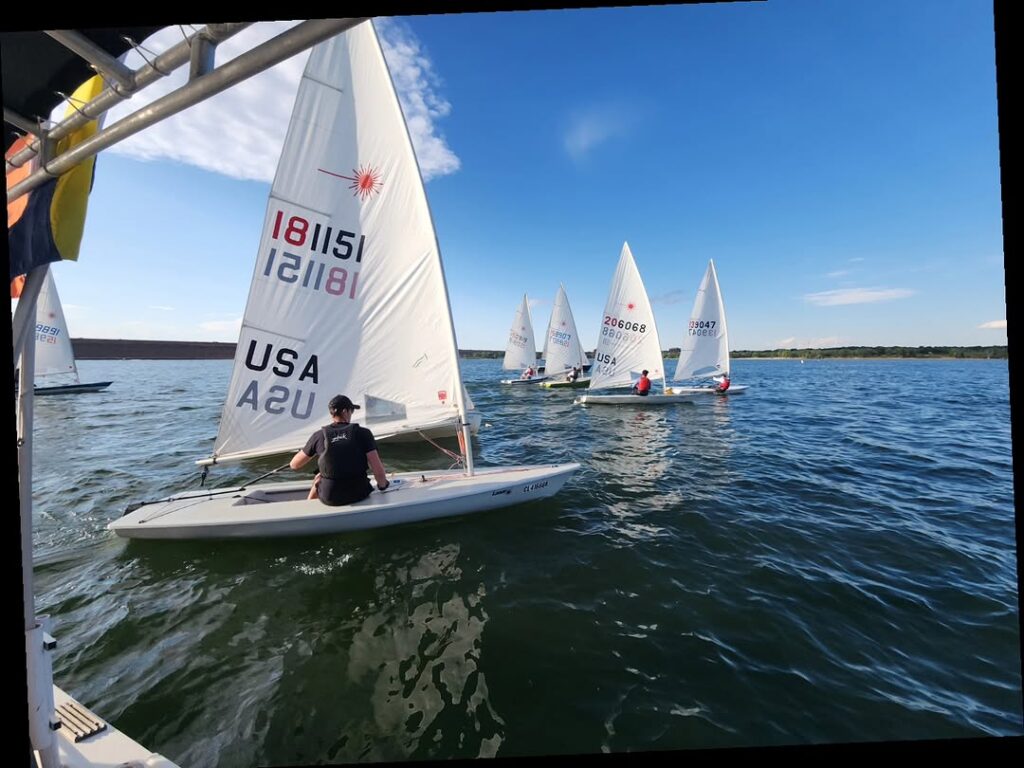
Start Racing
Step 1: Learn to Sail
Community Sailing of Colorado provides a great environment for youth and adults learn how to sail on large stable keelboats.
Step 2: Learn Dinghy Sailing
Gain the skills to transition to sailing independently without an instructor on smaller dinghy boats.
Step 3: Learn to Race
Community Sailing of Colorado runs Learn to Race 1 and Learn to Race 2 classes on Thursday night in conjunction with Denver Sailing Association’s Fleet Series Races. What better way to learn than by applying your knowledge on the starting line?
Each session begins with an onshore lesson covering a focused racing topic—such as starts, mark roundings, tactics, or rules—followed by on-the-water coaching as you participate in the race. You’ll gain hands-on experience in a supportive, welcoming racing environment while building confidence, strategy, and boat speed.
The Level 1 class will cover the basics of racing: rules of the road, starting sequences, mark roundings, fouls, and protests.
The Level 2 class will cover racing tactics and strategy: lay lines, reading the wind, spinnaker work, and decision making.
Step 4: Know What to Read
All sailing events will have 2 important documents that will tell you everything you need to know to participate. A “Notice” will come out at least 90 days ahead of the event telling you what, when, where, and how to participate. A “Sailing Instruction” will then be provided to tell you all the rules the event will be operating with on top of the standard Racing Rules of Sailing (RRS) published by World Sailing, our sport’s world governing body.
Notice of Race (NOR) & Notice of Series (NOS)?
The Notice of Race (NOR) exists to set out the conditions under which a Regatta will be run. It provides a competitor with enough information to decide whether they wish to participate and to plan on attending.
The NOR is a formal offer to all potential competitors describing the conditions under which they will be allowed to participate in a regatta/race. These conditions should not vary from publication to the actual event. An NOR is concerned with racing and should not include any of the social events that may be associated with the racing. For example, an NOR might say that racing will not begin before 11:00hrs and will be finished by 17:00hrs. A competitor would have a valid complaint if racing took place outside these times.
Clubs typically run a variety of races during a season. It is difficult to publish separate NORs for every event in a club calendar. It is acceptable for clubs to publish a Notice of Series (NOS) for their complete season, with reference to all appropriate information. This approach can be used in conjunction with specific NORs for certain events that do not conform to the general pattern of the club racing, i.e. Open Regattas.
There are six items that must be included in a NOR:
- Title, place and date, and the organizing authority
- Event governed by the Racing Rules of Sailing (RRS)
- List of other documents governing the racing, State, County, City, Park, regulations
- Eligibility requirements, Classes, Memberships, handicaps & conditions of entry, and price
- Procedure and times for registration or entry
- Times of Racing & their Warning Signals
NOR and NOS documents can be found under their respective event information pages on the website.
Sailing Instructions (SIs)
Sailing instructions (SIs) are essential documents that provide detailed guidelines and
rules for participants in sailing races. They are based on & reference the Racing Rules of Sailing (RRS) as published by US Sailing for the current sailing year. Here are some key points about SIs:
- Purpose: Sailing instructions focus exclusively on the racing aspects of the
current event(s). They do not include information about social events, marina
access, slip or mooring assignments, or any other non-racing matters. - Content: SIs outline the intentions of the Race Committee (RC) and the Protest
Committee (PC). They also specify the competitors’ obligations. Importantly, SIs
should not alter the fundamental RRS unless it is clearly necessary. If a change is
made, it must explicitly reference the RRS rule being modified. - Order and Clarity: SIs should be organized in the sequence that competitors will
use them. They should avoid repetition and restate only essential information.
RRS references within SIs use abbreviations like “RRS” (The Racing Rules of
Sailing), “NOR” (notice of race), and “SI” (sailing instructions). - Discretionary Penalties: If an SI item is subject to any discretionary penalties, it
should be marked with “[DP]” (see RRS Introduction Notation). - Recommended Wording: Appendix L of the RRS provides suggested wording for
various sections of SIs. These include headings, rules, and event-specific details.
The guide ensures consistency and compliance with the RRS. - Event-Specific Information: SIs should include the full name of the event, dates,
organizing authority, and location. Additionally, they may modify specific rules
(e.g., penalty systems, scoring systems) as needed.
Remember that SIs play a crucial role in ensuring fair and competitive sailing races, and they are tailored to each event’s unique requirements.
SIs can be found under their respective event information pages on the website.
Step 5: Know When to Show Up
For our club’s regular series races, you will see a “First Warning Signal” time listed in 24hr format. This time is when races start at the start line. Boats typically leave shore/the docks at least 30 minutes before this start time to sail out to the start line. Teams typically show up at least a 30 minutes to an hour before leaving shore/the docks to rig their boats. Therefore, new racers should plan to get to Cherry Creek Marina at least an hour and a half before the First Warning Signal time.
Step 6: Find a Boat to Race
Option 1: Buy a Boat
Option 2: Use a Club Boat
DSA has a limited number of club boats available for small boat sailing certified Admiral Members to use during club events. US Sailing Level 1 instructors can test and certify small boat sailors. There are US Sailing Level 1 instructors within the DSA club who are available to run small boat sailing skill tests.
Option 3: Volunteer with Community Sailing of Colorado
Instructors at Community Sailing of Colorado (CSC) have the ability to use CSC’s boats to race in DSA events when available. Trade a bit of time and expertise as a sailing instructor and you can have a boat to race. For more information, contact [email protected].
Option 4: Join the Why Buy Club
This sailboat timeshare has a fleet of J22 keelboats at Cherry Creek Reservoir that are available to program subscribers with ASA certifications. Learn more at victoriasailingschool.com/why-buy. (Pro tip: you can bring and use your own set of sails for better performance.)
Step 7: Grab a Membership
You’re ready to start racing! Sign up for a DSA membership and show up to our weekly fleet series races.
Step 8: Start Fleet Series Racing
Step 9: Learn to & Start Team Race (Optional)
Watch this playlist of 15 videos to get a crash course in team racing. Once you’ve got the concepts down, show up for our team series races.